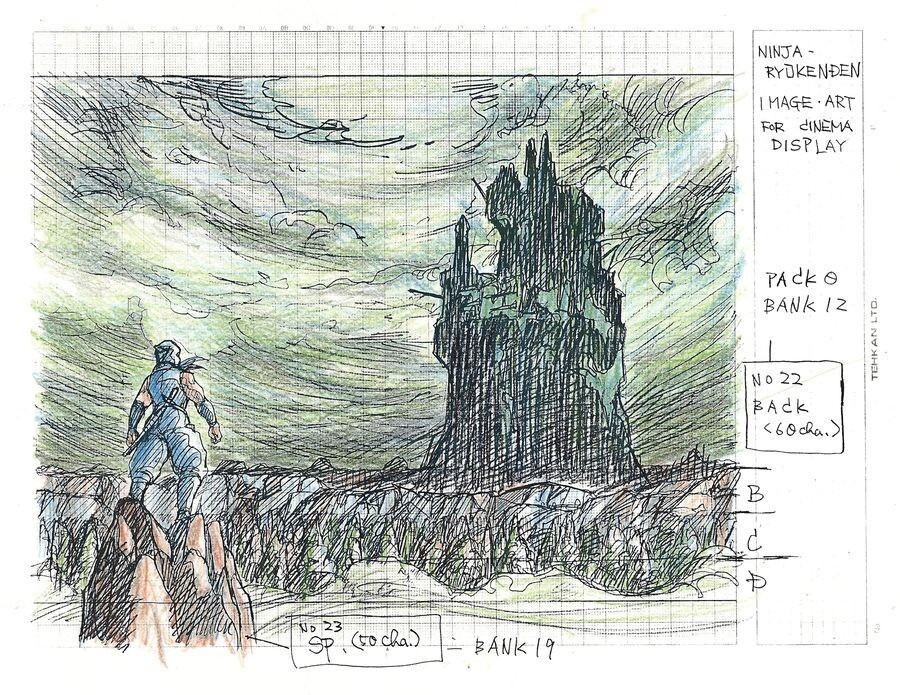
Tecmo’s president wanted an arcade game and a Famicom game developed at the same time, both called Ninja Gaiden. The shared title led players to assume the home version was an arcade port. In the third part of a retrospective interview, director and producer Hideo Yoshizawa recalled that the two teams had been free to make quite different games.
The arcade designer, a colleague Yoshizawa identified only as I, built his game around a grip-shaped joystick with a button under the player’s thumb. Pressing it let the ninja hang from objects or execute a throw. The unusual hardware could catch a player’s eye across an arcade, and Tecmo could charge more by selling the game with its control panel. Yoshizawa, meanwhile, wanted to give Ryu Hayabusa a more cinematic presence on the Famicom. Once the two men had compared plans, he said, neither interfered with the other’s work.
A checkpoint before cartridge production
Nintendo manufactured the Famicom cartridges, and its in-house Mario Club testers checked the finished game before production could begin. They found no bugs that would prevent players from progressing, Yoshizawa recalled, but they did suggest a level in which the ninja could swim. It was too late to build one. Yoshizawa also thought swimming would slow the action down too much.
Nintendo gave the game a prominent place at a trade show: a cylindrical display in the center of the venue, reserved for titles Nintendo chose to support. Yoshizawa said orders from wholesalers and distributors reached 300,000 copies. He separately estimated that the game sold about 300,000 copies in Japan.
After the Japanese release, Yoshizawa’s former boss Kazutoshi Ueda invited him to dinner. Ueda credited the game’s success to its opening sequence and the stylized scenes between levels. What stayed with Yoshizawa was that Ueda saw something distinctly his in those sequences. He recalled it as the moment he realized he wanted to keep developing that sensibility and find other ways to use it in games.
An English script and a three-month wait for cartridges
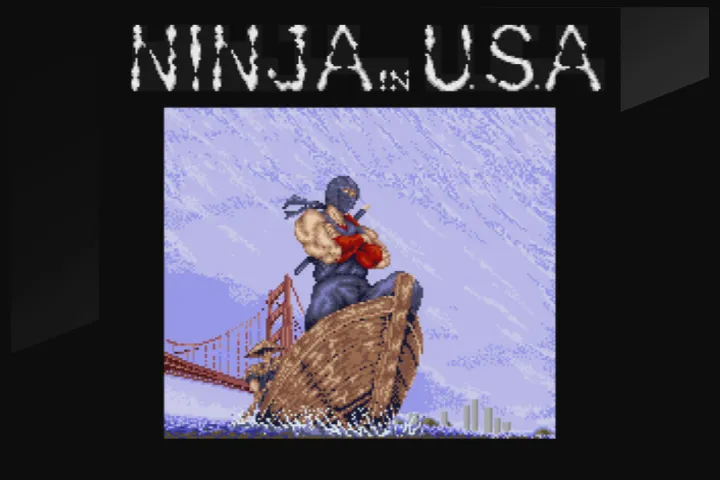
When an outside company delivered the English translation, Yoshizawa and artist Kato spotted passages they wanted to discuss with the translator. Daniel Kahl, who later became known for his television appearances, met with them to work through the details of the story. Yoshizawa credited Kahl’s willingness to listen for the quality of the English script. One name changed between versions: Ryu’s father, Joe in Japanese, became Ken in English, after the then-president of Tecmo’s US operation.
Ninja Gaiden reached the US on the NES in March 1989. Yoshizawa was in Japan working on his next project, so his first picture of the launch came from a report describing long checkout lines, stores running out of stock and players trying one shop after another to find a copy. Hearing that people were going to that trouble meant more to him than the sales figure itself, he said.
Tecmo decided to replenish stock immediately, but a cartridge order took about three months to ship. Yoshizawa worried that interest would fade in the meantime. By his account, US sales continued to grow and eventually reached about 1.5 million copies. The success prompted Tecmo’s president to ask what Yoshizawa thought of having Steven Spielberg make a film of the story. Yoshizawa liked the idea, but said nothing came of it.
Why Ryu outran the slowdown in Europe
European PAL televisions refreshed at five-sixths the rate of sets in Japan and North America. Without changes to the program, the whole game would run at five-sixths speed. The team did not have time to adjust and test everything, so it sped up Ryu alone. Players could move him as quickly as in the Japanese release, while enemies still moved at five-sixths of their original speed.
Playing that version, Yoshizawa was surprised by how right the difficulty felt. It made him wonder whether the original enemies had been too fast. He stopped short of calling the European version better, though: for players who had mastered the original, he thought, that relentless pace might have been precisely the appeal.